Wikipedia ( wik-ih-PEE-dee-ə or wik-ee-) is a free content, multilingual online encyclopedia written and maintained by a community of volunteer contributors through a model of open collaboration, using a wiki-based editing system. Wikipedia is the largest and most-read reference work in history,[3] and is consistently one of the 15 most popular websites as ranked by Alexa; as of 2021, it was ranked as the 13th most popular site.[3][4] The project carries no advertisements and is hosted by the Wikimedia Foundation, an American non-profit organization funded mainly through small donations.[5]
Wikipedia was launched on January 15, 2001, by Jimmy Wales[6] and Larry Sanger; Sanger coined its name as a blending of "wiki" and "encyclopedia".[7][8] Initially available only in English, versions in other languages were quickly developed. Combined, Wikipedia's editions comprise more than 56 million articles, that attract an average of around 2 billion unique device visits and receive more than 17 million edits per month, or develop at a rate of 1.9 edits per second.[9][10]
Wikipedia has received praise for its enablement of the democratization of knowledge, extent of coverage, unique structure, culture, and reduced amount of commercial bias, but criticism for exhibiting systemic bias, particularly gender bias against women.[11] Its reliability was frequently criticized in the 2000s, but has improved over time and has been generally praised in the late 2010s and 2020s.[12][3][11] Its coverage of controversial topics such as American politics and major events such as the COVID-19 pandemic has received substantial media attention. At various points, Wikipedia has been censored by world governments, ranging from the blocking of specific pages to bans on the entire site. Wikipedia has become an element of popular culture, with references in books, films and academic studies. In 2018, Facebook and YouTube announced that they would help users detect fake news by suggesting fact-checking links to related Wikipedia articles.[13][14]
History
Nupedia

Wikipedia originally developed from another encyclopedia project called
Nupedia.
Other collaborative online encyclopedias were attempted before Wikipedia, but none were as successful.[15] Wikipedia began as a complementary project for Nupedia, a free online English-language encyclopedia project whose articles were written by experts and reviewed under a formal process.[16] It was founded on March 9, 2000, under the ownership of Bomis, a web portal company. Its main figures were Bomis CEO Jimmy Wales and Larry Sanger, editor-in-chief for Nupedia and later Wikipedia.[1][17] Nupedia was initially licensed under its own Nupedia Open Content License, but even before Wikipedia was founded, Nupedia switched to the GNU Free Documentation License at the urging of Richard Stallman.[18] Wales is credited with defining the goal of making a publicly editable encyclopedia,[19][20] while Sanger is credited with the strategy of using a wiki to reach that goal.[21] On January 10, 2001, Sanger proposed on the Nupedia mailing list to create a wiki as a "feeder" project for Nupedia.[22]
Launch and early growth
The domains wikipedia.com (redirecting to wikipedia.org) and wikipedia.org were registered on January 12, 2001,[23] and January 13, 2001,[24] respectively, and Wikipedia was launched on January 15, 2001,[16] as a single English-language edition at www.wikipedia.com,[25] and announced by Sanger on the Nupedia mailing list.[19] Wikipedia's policy of "neutral point-of-view"[26] was codified in its first few months. Otherwise, there were relatively few rules initially and Wikipedia operated independently of Nupedia.[19] Originally, Bomis intended to make Wikipedia a business for profit.[27]

The Wikipedia home page on December 20, 2001
English Wikipedia editors with >100 edits per month
[28]Number of English Wikipedia articles
[29]Wikipedia gained early contributors from Nupedia, Slashdot postings, and web search engine indexing. Language editions were also created, with a total of 161 by the end of 2004.[30] Nupedia and Wikipedia coexisted until the former's servers were taken down permanently in 2003, and its text was incorporated into Wikipedia. The English Wikipedia passed the mark of two million articles on September 9, 2007, making it the largest encyclopedia ever assembled, surpassing the Yongle Encyclopedia made during the Ming Dynasty in 1408, which had held the record for almost 600 years.[31]
Citing fears of commercial advertising and lack of control in Wikipedia, users of the Spanish Wikipedia forked from Wikipedia to create the Enciclopedia Libre in February 2002.[32] Wales then announced that Wikipedia would not display advertisements, and changed Wikipedia's domain from wikipedia.com to wikipedia.org.[33][34]
Though the English Wikipedia reached three million articles in August 2009, the growth of the edition, in terms of the numbers of new articles and of contributors, appears to have peaked around early 2007.[35] Around 1,800 articles were added daily to the encyclopedia in 2006; by 2013 that average was roughly 800.[36] A team at the Palo Alto Research Center attributed this slowing of growth to the project's increasing exclusivity and resistance to change.[37] Others suggest that the growth is flattening naturally because articles that could be called "low-hanging fruit"—topics that clearly merit an article—have already been created and built up extensively.[38][39][40]
In November 2009, a researcher at the Rey Juan Carlos University in Madrid found that the English Wikipedia had lost 49,000 editors during the first three months of 2009; in comparison, the project lost only 4,900 editors during the same period in 2008.[41][42] The Wall Street Journal cited the array of rules applied to editing and disputes related to such content among the reasons for this trend.[43] Wales disputed these claims in 2009, denying the decline and questioning the methodology of the study.[44] Two years later, in 2011, Wales acknowledged the presence of a slight decline, noting a decrease from "a little more than 36,000 writers" in June 2010 to 35,800 in June 2011. In the same interview, Wales also claimed the number of editors was "stable and sustainable".[45] A 2013 article titled "The Decline of Wikipedia" in MIT Technology Review questioned this claim. The article revealed that since 2007, Wikipedia had lost a third of its volunteer editors, and those still there have focused increasingly on minutiae.[46] In July 2012, The Atlantic reported that the number of administrators is also in decline.[47] In the November 25, 2013, issue of New York magazine, Katherine Ward stated "Wikipedia, the sixth-most-used website, is facing an internal crisis".[48]
Milestones
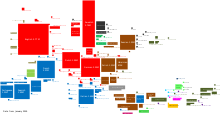
Cartogram showing number of articles in each European language as of January 2019. One square represents 10,000 articles. Languages with fewer than 10,000 articles are represented by one square. Languages are grouped by language family and each language family is presented by a separate color.
In January 2007, Wikipedia entered for the first time the top-10 list of the most popular websites in the US, according to comscore Networks. With 42.9 million unique visitors, Wikipedia was ranked at No. 9, surpassing The New York Times (No. 10) and Apple (No. 11). This marked a significant increase over January 2006, when the rank was 33rd, with Wikipedia receiving around 18.3 million unique visitors.[49] As of March 2020, Wikipedia ranked 13th[4] among websites in terms of popularity according to Alexa Internet. In 2014, it received eight billion page views every month.[50] On February 9, 2014, The New York Times reported that Wikipedia has 18 billion page views and nearly 500 million unique visitors a month, "according to the ratings firm comScore".[9] Loveland and Reagle argue that, in process, Wikipedia follows a long tradition of historical encyclopedias that accumulated improvements piecemeal through "stigmergic accumulation".[51][52]
On January 18, 2012, the English Wikipedia participated in a series of coordinated protests against two proposed laws in the United States Congress—the Stop Online Piracy Act (SOPA) and the PROTECT IP Act (PIPA)—by blacking out its pages for 24 hours.[53] More than 162 million people viewed the blackout explanation page that temporarily replaced Wikipedia content.[54][55]
On January 20, 2014, Subodh Varma reporting for The Economic Times indicated that not only had Wikipedia's growth stalled, it "had lost nearly ten percent of its page views last year. There was a decline of about two billion between December 2012 and December 2013. Its most popular versions are leading the slide: page-views of the English Wikipedia declined by twelve percent, those of German version slid by 17 percent and the Japanese version lost nine percent."[56] Varma added that "While Wikipedia's managers think that this could be due to errors in counting, other experts feel that Google's Knowledge Graphs project launched last year may be gobbling up Wikipedia users."[56] When contacted on this matter, Clay Shirky, associate professor at New York University and fellow at Harvard's Berkman Klein Center for Internet & Society indicated that he suspected much of the page view decline was due to Knowledge Graphs, stating, "If you can get your question answered from the search page, you don't need to click [any further]."[56] By the end of December 2016, Wikipedia was ranked fifth in the most popular websites globally.[57]
In January 2013, 274301 Wikipedia, an asteroid, was named after Wikipedia; in October 2014, Wikipedia was honored with the Wikipedia Monument; and, in July 2015, 106 of the 7,473 700-page volumes of Wikipedia became available as Print Wikipedia. In April 2019, an Israeli lunar lander, Beresheet, crash landed on the surface of the Moon carrying a copy of nearly all of the English Wikipedia engraved on thin nickel plates; experts say the plates likely survived the crash.[58][59] In June 2019, scientists reported that all 16 GB of article text from the English Wikipedia have been encoded into synthetic DNA.[60]
Openness

Differences between versions of an article are highlighted
Unlike traditional encyclopedias, Wikipedia follows the procrastination principle[note 3] regarding the security of its content.[61]
Restrictions
Due to the increasing popularity of Wikipedia, some editions, including the English version, have introduced editing restrictions for certain cases. For instance, on the English Wikipedia and some other language editions, only registered users may create a new article.[62] On the English Wikipedia, among others, particularly controversial, sensitive or vandalism-prone pages have been protected to varying degrees.[63][64] A frequently vandalized article can be "semi-protected" or "extended confirmed protected", meaning that only "autoconfirmed" or "extended confirmed" editors are able to modify it.[65] A particularly contentious article may be locked so that only administrators are able to make changes.[66] A 2021 article in the Columbia Journalism Review identified Wikipedia's page protection policies as "[p]erhaps the most important" means at Wikipedia's disposal to "regulate its market of ideas".[67]
In certain cases, all editors are allowed to submit modifications, but review is required for some editors, depending on certain conditions. For example, the German Wikipedia maintains "stable versions" of articles,[68] which have passed certain reviews. Following protracted trials and community discussion, the English Wikipedia introduced the "pending changes" system in December 2012.[69] Under this system, new and unregistered users' edits to certain controversial or vandalism-prone articles are reviewed by established users before they are published.[70]

The editing interface of Wikipedia
Review of changes
Although changes are not systematically reviewed, the software that powers Wikipedia provides tools allowing anyone to review changes made by others. The "History" page of each article links to each revision.[note 4][71] On most articles, anyone can undo others' changes by clicking a link on the article's history page. Anyone can view the latest changes to articles, and anyone registered may maintain a "watchlist" of articles that interest them so they can be notified of any changes. "New pages patrol" is a process whereby newly created articles are checked for obvious problems.[72]
In 2003, economics Ph.D. student Andrea Ciffolilli argued that the low transaction costs of participating in a wiki create a catalyst for collaborative



.png)


